


About customer
The client was an author-driven project created by a married couple of entrepreneurs with international experience in both business and public administration. Their debut literary work was the intellectual thriller The Fifth Magnificent. Nylon Heart - a narrative at the intersection of technology, philosophy, and social reflection.
The book was never conceived as a traditional commercial product. According to the client, it was intended as a cultural and intellectual contribution - an attempt to artistically explore the impact of the digital environment, artificial intelligence, and digital footprints on the modern individual.
The authors themselves were not public figures and had no intention of actively participating in media promotion. The project required a delicate form of presence - a way to speak to audiences on the author’s behalf without compromising privacy.
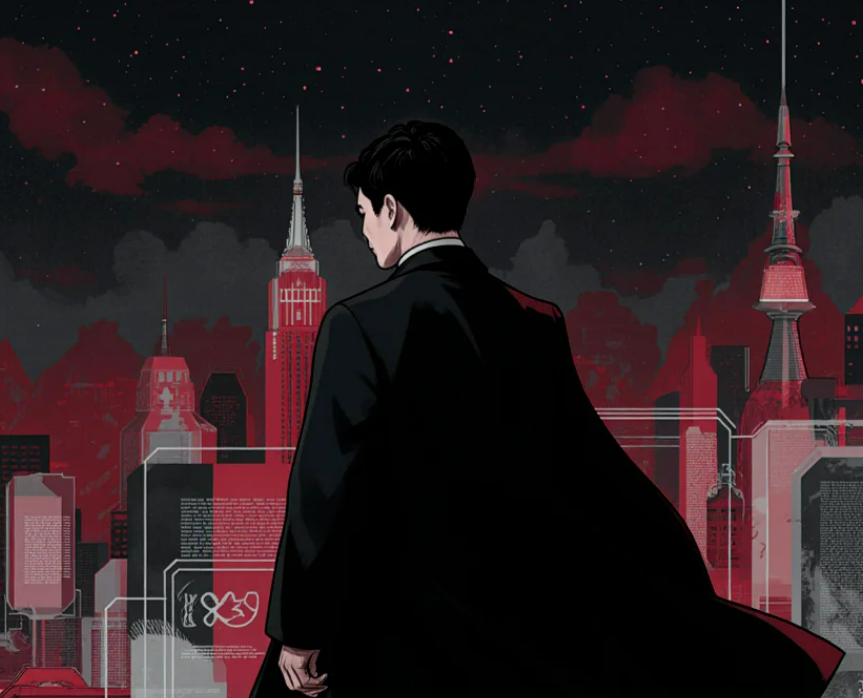
At its core, the book blends a gripping investigation with philosophical depth. The plot follows a series of mysterious murders and profiler Chen Kun investigates crimes that leave almost no digital traces. A recurring motif is the duality of technological progress: the artificial that appears disturbingly alive, and a human gradually losing the boundary between physical and digital reality.
This meant the team faced more than a marketing challenge. It was an exercise in working with a subtle authorial statement — a project where technology had to become an extension of the idea, not merely a promotional tool.
Starting Point
The connection with Awara IT began after an industry event - the client remembered the company and later reached out independently. At the first meeting, the core idea was introduced: to create a digital avatar of the author that would support the book’s promotion while organically fitting its conceptual framework. Since artificial intelligence plays a key thematic role in the story, the technological solution had to amplify the idea rather than simply support marketing.
Market context was crucial. Digital avatar projects did exist, but they were extremely niche. Most were created by video production studios or marketing agencies, treating avatars primarily as promotional tools.
Geographically, such projects were concentrated mainly in Central Europe, with isolated cases in Spain, as well as Mexico and Portugal.
At the time, no comparable projects had been implemented in Kazakhstan.
These solutions were typically bespoke and non-scale unique builds designed for a single client. They were expensive, highly customized productions with budgets in the hundreds of thousands of dollars, sometimes nearing a million, lacking any platform approach or scalability.
Against this backdrop, it became clear that the client’s idea required more than creative execution. It demanded a technological leap - a scalable, flexible, and accessible solution that moved beyond the traditional advertising format.
Challenges and solutions
The team faced a multilayered task: to create a digital entity capable of:- acting as the author’s media representative,
- giving interviews and answering questions from readers and journalists,
- preserving the author’s intellectual tone and stylistic voice,
- aligning organically with the book’s philosophy.
The project needed to resolve a paradox: enabling public presence without the author’s actual participation in media space.
An additional layer of complexity came from the book’s thematic depth. The technology was not meant to imitate the author but to reinforce the book’s ideas about the dual nature of artificial intelligence.
The Solution
The team developed a digital avatar of the author — an autonomous media entity capable of speaking in the first person and conveying the author’s perspective.
The avatar was named Zoya and presented as a digital embodiment of the author - transparent in nature, yet compelling in communication.
The solution was built as a hybrid AI product composed of several layers:
1. Semantic Core Model
- training on the book’s text and author materials,
- development of a stylistic author profile,
- embedding philosophical and conceptual communication boundaries.
2. Speech Behavior Model
- tuning tone and rhetorical patterns,
- maintaining an analytical, intellectual voice,
- ensuring consistency across different interview formats.
3. Content Logic Layer
- scenario templates for interviews and public appearances,
- controlled thematic domains: plot, technology, AI ethics, author’s perspective,
- guardrails to ensure authenticity and privacy.
4. Media Layer
- creation of a digital persona (name, character, voice),
- adaptation for PR formats: interviews, publications, publishing materials.
-
Narrative credibility was critical. The avatar could not feel like a technological gimmick - it had to function as a natural extension of the book’s artistic universe.
Try talking to a character from The Fifth Magnificent here.
Results
The project became one of the first meaningful examples of using a digital author avatar in the region — not as a marketing stunt, but as a true mediator between idea and audience.
- preserving the author’s privacy
- creating an entirely new format of media presence,
- reinforcing the philosophical dimension of the book through form itself,
- building a distinctive PR instrument.
-
A key outcome was the emergence of a new kind of author–audience dialogue. The digital avatar appeared in interviews and media features, speaking in the first person: sharing insights about the author, раскрывая themes and symbolism, reflecting on anxieties surrounding artificial intelligence, and addressing the risks of digital footprints.
The communication was perceived not as promotion, but as an intellectual experiment - a convergence point between literature and technology, where form amplified meaning.
The project’s significance was further reinforced by international recognition: the book was nominated in China for the national TIANWEN Award for Original Story. This milestone elevated the project’s media weight and validated the chosen digital strategy.
Why is this project significant
The project marked a transition from one-off experimental avatars to meaningful digital characters embedded within cultural context.
It demonstrated that a digital avatar can be more than a technological or marketing tool - it can become a form of authorship, a way of speaking to the world at the intersection of literature, technology, and philosophy.
In this case, technology did not replace the author but extended them - reflecting the book’s core idea: everything artificial eventually begins to look unsettlingly alive.
And at that precise point, form and content converged.
Awara IT takes on challenges that initially seem unsolvable.
We thrive on projects at the edge of technology and meaning — where no ready-made solutions exist and new formats must be invented from scratch.
If you’re facing a challenge no one has solved yet, that might just be where the next great case begins.
